



Polychrome and Giltwood Quatrefoil Display Riser / Plateau
Polychrome and Giltwood Quatrefoil Display Riser / Plateau
Impossible de charger la disponibilité du service de retrait
Partager


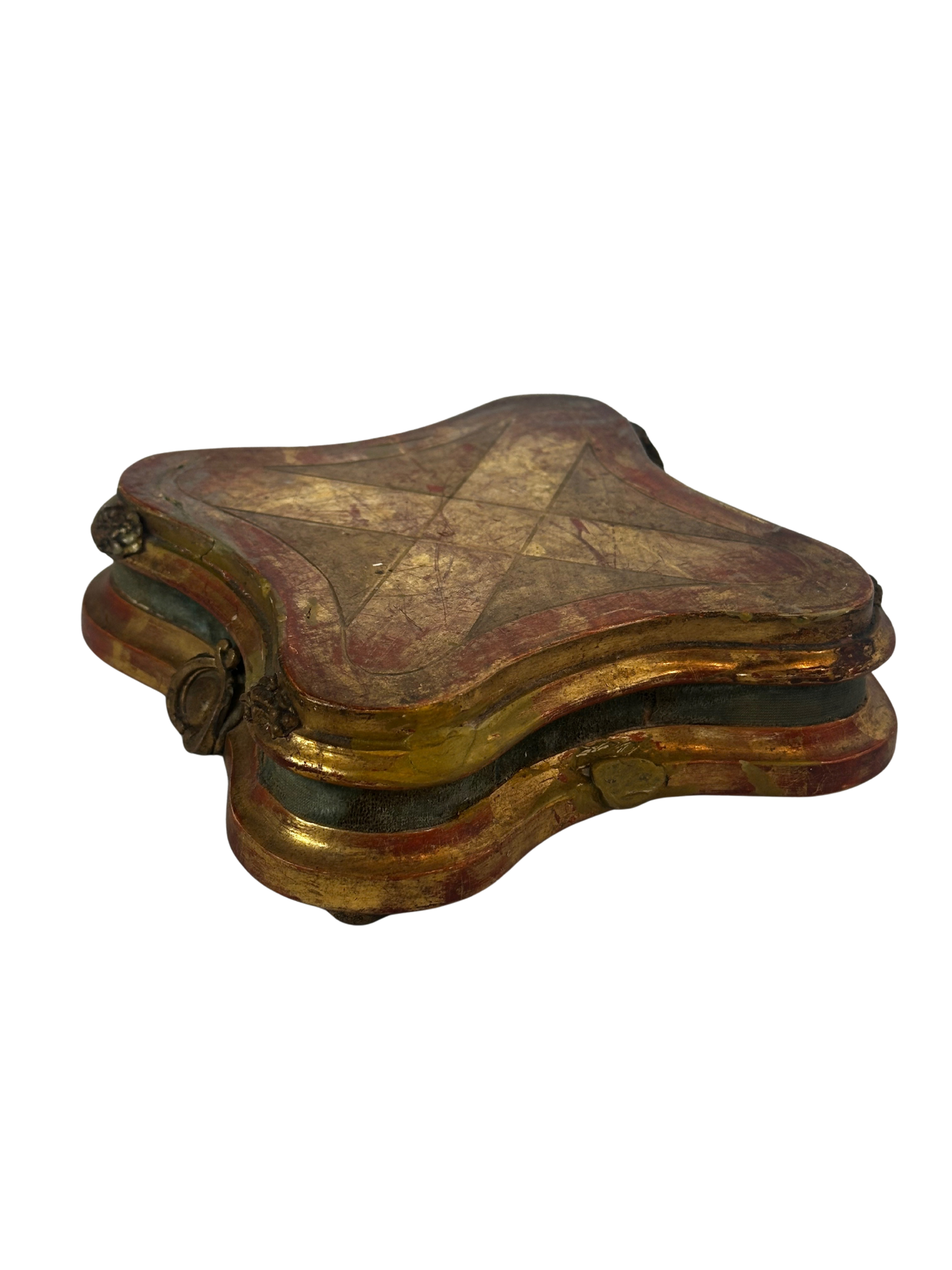
Carved wooden display riser (plateau) of quatrefoil form with a flat top surface. The top is decorated with incised linear geometric motifs arranged in a star-like pattern. The sides are built up in tiered moldings, alternating between water-gilded surfaces and painted polychrome bands in green, red, and ochre tones. Applied carved wooden ornaments accent the lobed edges. The front features a central applied decorative element. The underside shows hand-shaped contours, early nail use, and old drill holes consistent with pre-industrial construction. Intended to elevate and display decorative or devotional objects such as bronzes, clocks, busts, or figures.
Carved wooden display riser (plateau) of quatrefoil form with a flat top surface. The top is decorated with incised linear geometric motifs arranged in a star-like pattern. The sides are built up in tiered moldings, alternating between water-gilded surfaces and painted polychrome bands in green, red, and ochre tones. Applied carved wooden ornaments accent the lobed edges. The front features a central applied decorative element. The underside shows hand-shaped contours, early nail use, and old drill holes consistent with pre-industrial construction. Intended to elevate and display decorative or devotional objects such as bronzes, clocks, busts, or figures.
2"h x 5.5"w x 5.5"d
2"h x 5.5"w x 5.5"d
Display risers of this type were used in European interiors to elevate objects and create visual hierarchy on tables, mantels, and within cabinets. During the early 19th century, traditional woodworking, gesso preparation, polychrome painting, and water-gilding techniques continued to be employed, particularly in Continental workshops. The restrained symmetry and linear incised decoration reflect Neoclassical influence prevalent during this period.
Display risers of this type were used in European interiors to elevate objects and create visual hierarchy on tables, mantels, and within cabinets. During the early 19th century, traditional woodworking, gesso preparation, polychrome painting, and water-gilding techniques continued to be employed, particularly in Continental workshops. The restrained symmetry and linear incised decoration reflect Neoclassical influence prevalent during this period.
Early to Mid 19th Century (c. 1800–1840)
Early to Mid 19th Century (c. 1800–1840)
Carved wood; gesso; water gilding; polychrome-painted decoration
Carved wood; gesso; water gilding; polychrome-painted decoration
Continental Europe
Continental Europe
Surface wear, paint loss, and gilding loss consistent with age; abrasions to the top surface from use; minor losses to carved ornamentation; underside wear and old nail holes.
Surface wear, paint loss, and gilding loss consistent with age; abrasions to the top surface from use; minor losses to carved ornamentation; underside wear and old nail holes.