


Portrait Miniature Likely Depicting Wilhelmine Herzlieb on Mother-of-Pearl in Crowned Gilt Brass Frame
Portrait Miniature Likely Depicting Wilhelmine Herzlieb on Mother-of-Pearl in Crowned Gilt Brass Frame
Impossible de charger la disponibilité du service de retrait
Partager


Elegant early 19th-century portrait miniature possibly depicting Wilhelmine Herzlieb (1789–1865), the celebrated muse associated with Johann Wolfgang von Goethe. The sitter is rendered in delicate watercolor and gouache on a luminous mother-of-pearl shell wafer, portraying a young woman with expressive dark eyes, elaborate ringlet curls, elongated neck, and softly draped Regency-era attire accented with gilt detailing and a rich teal-blue shawl.
The miniature is housed within an ornate oval gilt brass frame surmounted by an elaborate openwork crown crest and bordered with repeating fleur-de-lis motifs. Surrounding the portrait is its original plush velvet or silk velvet liner in a pale mauve-gray tone, giving the work a refined jewel-like presentation characteristic of Victorian romantic decorative arts.
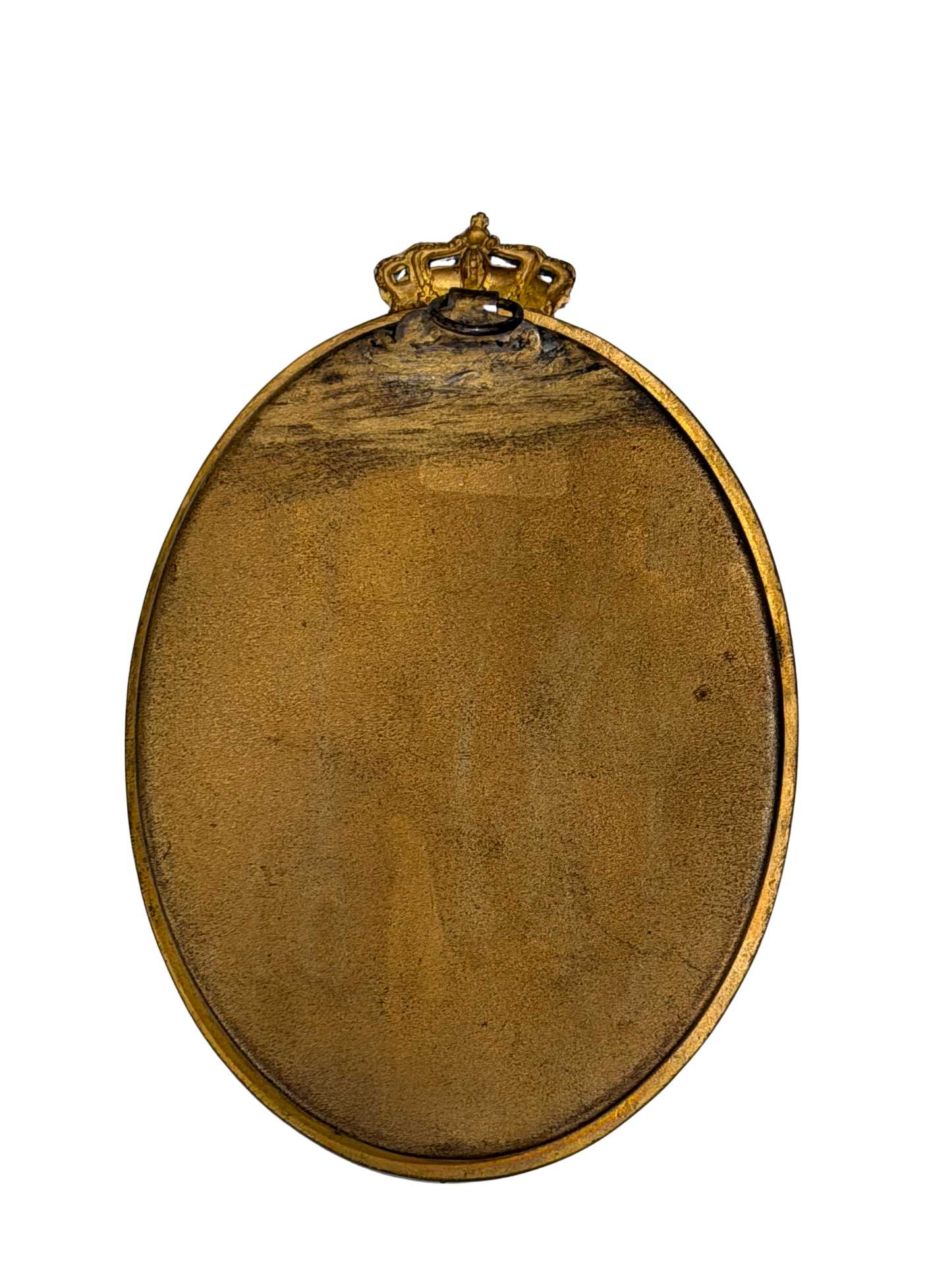
Construction details visible from the reverse — including folded brass retaining tabs, layered paper backing, and stamped brass framework — suggest the frame dates to the later 19th century, while the portrait itself appears stylistically earlier. It was likely treasured and reframed during the Victorian period, a common practice for sentimental or literary-associated portrait miniatures.
Particularly notable is the translucent quality of the support material. Under direct backlighting, the image becomes faintly visible through the reverse, strongly supporting the use of mother-of-pearl shell rather than paper. Fine natural striations visible under magnification further reinforce this identification.
The sitter bears a notable resemblance to known romanticized depictions associated with Wilhelmine Herzlieb — particularly the softly idealized facial structure, curls, and introspective expression frequently seen in early 19th-century German and Continental portraiture inspired by Goethe’s circle.
Elegant early 19th-century portrait miniature possibly depicting Wilhelmine Herzlieb (1789–1865), the celebrated muse associated with Johann Wolfgang von Goethe. The sitter is rendered in delicate watercolor and gouache on a luminous mother-of-pearl shell wafer, portraying a young woman with expressive dark eyes, elaborate ringlet curls, elongated neck, and softly draped Regency-era attire accented with gilt detailing and a rich teal-blue shawl.
The miniature is housed within an ornate oval gilt brass frame surmounted by an elaborate openwork crown crest and bordered with repeating fleur-de-lis motifs. Surrounding the portrait is its original plush velvet or silk velvet liner in a pale mauve-gray tone, giving the work a refined jewel-like presentation characteristic of Victorian romantic decorative arts.
Construction details visible from the reverse — including folded brass retaining tabs, layered paper backing, and stamped brass framework — suggest the frame dates to the later 19th century, while the portrait itself appears stylistically earlier. It was likely treasured and reframed during the Victorian period, a common practice for sentimental or literary-associated portrait miniatures.
Particularly notable is the translucent quality of the support material. Under direct backlighting, the image becomes faintly visible through the reverse, strongly supporting the use of mother-of-pearl shell rather than paper. Fine natural striations visible under magnification further reinforce this identification.
The sitter bears a notable resemblance to known romanticized depictions associated with Wilhelmine Herzlieb — particularly the softly idealized facial structure, curls, and introspective expression frequently seen in early 19th-century German and Continental portraiture inspired by Goethe’s circle.
5"h x 3.5"w x 0.5"d
5"h x 3.5"w x 0.5"d
Wilhelmine Herzlieb was closely associated with Goethe during the late 1790s and early 1800s and has long occupied a romantic place in literary history. Adopted into the Herzlieb family in Jena, she became admired within intellectual circles and is widely believed to have inspired aspects of Goethe’s literary heroines. Goethe reportedly developed deep affection for her, and scholars have often connected her to his novel Die Wahlverwandtschaften (Elective Affinities).
Portrait miniatures served as intimate keepsakes before photography and were often exchanged among family members, admirers, or literary circles. During the Regency and Empire periods, artists experimented with luminous supports such as mother-of-pearl to create ethereal flesh tones and depth impossible on paper alone.
In the Victorian era, earlier miniatures were frequently reframed in ornate gilt brass mounts with crowns, fleur-de-lis, and velvet liners to elevate their decorative and sentimental appeal.
Wilhelmine Herzlieb was closely associated with Goethe during the late 1790s and early 1800s and has long occupied a romantic place in literary history. Adopted into the Herzlieb family in Jena, she became admired within intellectual circles and is widely believed to have inspired aspects of Goethe’s literary heroines. Goethe reportedly developed deep affection for her, and scholars have often connected her to his novel Die Wahlverwandtschaften (Elective Affinities).
Portrait miniatures served as intimate keepsakes before photography and were often exchanged among family members, admirers, or literary circles. During the Regency and Empire periods, artists experimented with luminous supports such as mother-of-pearl to create ethereal flesh tones and depth impossible on paper alone.
In the Victorian era, earlier miniatures were frequently reframed in ornate gilt brass mounts with crowns, fleur-de-lis, and velvet liners to elevate their decorative and sentimental appeal.
Portrait: Early 19th century, circa 1810–1835 Frame: Late 19th century Victorian
Portrait: Early 19th century, circa 1810–1835 Frame: Late 19th century Victorian
Watercolor and gouache on mother-of-pearl shell wafer, gilt brass frame, velvet/silk velvet liner, paper backing, brass retaining tabs
Watercolor and gouache on mother-of-pearl shell wafer, gilt brass frame, velvet/silk velvet liner, paper backing, brass retaining tabs
Likely Continental European, possibly German or French; Acquired in Texas
Likely Continental European, possibly German or French; Acquired in Texas
Age-related wear throughout including scattered spotting, light scratches, and surface imperfections consistent with age. Velvet liner exhibits wear and fading. Gilt brass frame retains oxidation and patina. Backing materials show expected deterioration and handling wear. No signature visible. Identification of the sitter as Wilhelmine Herzlieb is speculative and based on stylistic resemblance rather than documented attribution. Due to modern regulations, no guarantees are made regarding ivory; visible evidence strongly supports mother-of-pearl shell substrate.
Age-related wear throughout including scattered spotting, light scratches, and surface imperfections consistent with age. Velvet liner exhibits wear and fading. Gilt brass frame retains oxidation and patina. Backing materials show expected deterioration and handling wear. No signature visible. Identification of the sitter as Wilhelmine Herzlieb is speculative and based on stylistic resemblance rather than documented attribution. Due to modern regulations, no guarantees are made regarding ivory; visible evidence strongly supports mother-of-pearl shell substrate.