


Signed “Pugi” Italian Alabaster Bust of a Young Woman on Marble Plinth
Signed “Pugi” Italian Alabaster Bust of a Young Woman on Marble Plinth
Impossible de charger la disponibilité du service de retrait
Partager
Additional Description:
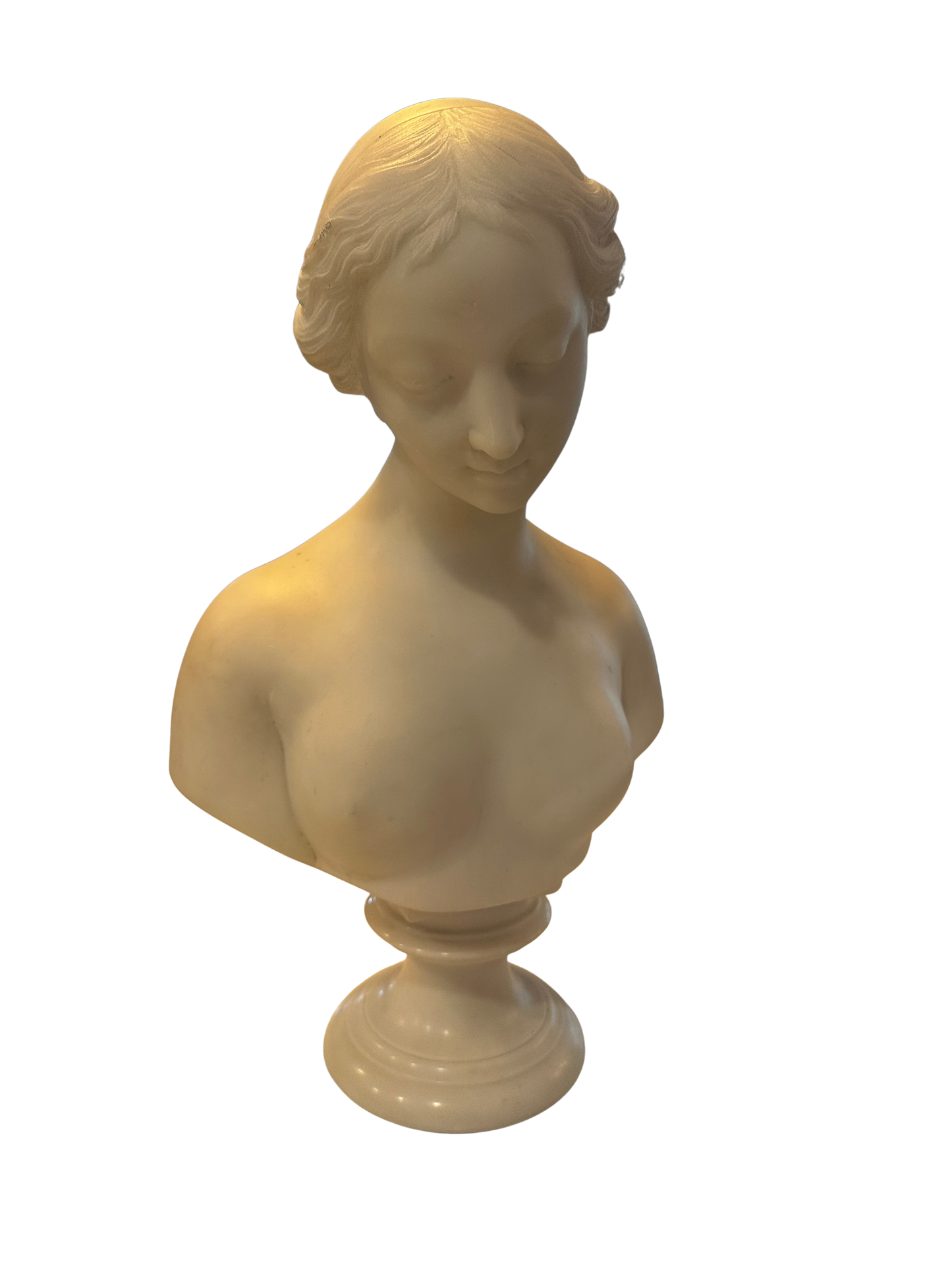
An elegant and finely sculpted Italian alabaster bust of a young woman, signed “Pugi” to the reverse, and raised on a contrasting marble plinth. The figure is depicted with a gently bowed head and closed eyes, embodying a serene, introspective beauty characteristic of late 19th-century neoclassical revival sculpture.
Her hair is arranged in a refined braided chignon, intricately carved with soft, naturalistic movement, while the face and torso are rendered with smooth, luminous surfaces that highlight the translucency of the alabaster. The bust is sensitively modeled, with graceful proportions and a quiet emotional presence.
The use of true alabaster for the figure, paired with a separate marble base, is consistent with higher-end Italian workshop production, particularly those associated with Florentine studios such as that of Guglielmo Pugi. These works were widely exported and prized for their refined craftsmanship and decorative appeal in sophisticated interiors.
A timeless and highly decorative sculptural piece, ideal for display in a cabinet, on a pedestal, or within a layered European interior.
Era:
Late 19th to early 20th century (circa 1890–1915)
History:
Guglielmo Pugi and his Florentine workshop produced some of the most recognizable decorative busts of the late 19th century. Drawing from neoclassical ideals and academic sculpture, these works often depicted idealized female forms intended for elegant domestic interiors. Alabaster examples, particularly those mounted on marble bases, were among the more desirable and higher-quality outputs of the workshop.
Provenance:
Italy, likely Florence; attributed to the workshop of Guglielmo Pugi
Materials:
Carved alabaster (figure), marble (base plinth)
Dimensions:
[Leave blank]
Disclaimers:
Wear consistent with age and handling, including minor surface marks, faint discoloration, and light scuffs visible in areas. Signature appears to read “Pugi,” though attribution should be considered workshop or in the manner of Pugi unless formally authenticated. Natural variation in alabaster is present and expected.
Additional Description:
An elegant and finely sculpted Italian alabaster bust of a young woman, signed “Pugi” to the reverse, and raised on a contrasting marble plinth. The figure is depicted with a gently bowed head and closed eyes, embodying a serene, introspective beauty characteristic of late 19th-century neoclassical revival sculpture.
Her hair is arranged in a refined braided chignon, intricately carved with soft, naturalistic movement, while the face and torso are rendered with smooth, luminous surfaces that highlight the translucency of the alabaster. The bust is sensitively modeled, with graceful proportions and a quiet emotional presence.
The use of true alabaster for the figure, paired with a separate marble base, is consistent with higher-end Italian workshop production, particularly those associated with Florentine studios such as that of Guglielmo Pugi. These works were widely exported and prized for their refined craftsmanship and decorative appeal in sophisticated interiors.
A timeless and highly decorative sculptural piece, ideal for display in a cabinet, on a pedestal, or within a layered European interior.
Era:
Late 19th to early 20th century (circa 1890–1915)
History:
Guglielmo Pugi and his Florentine workshop produced some of the most recognizable decorative busts of the late 19th century. Drawing from neoclassical ideals and academic sculpture, these works often depicted idealized female forms intended for elegant domestic interiors. Alabaster examples, particularly those mounted on marble bases, were among the more desirable and higher-quality outputs of the workshop.
Provenance:
Italy, likely Florence; attributed to the workshop of Guglielmo Pugi
Materials:
Carved alabaster (figure), marble (base plinth)
Dimensions:
[Leave blank]
Disclaimers:
Wear consistent with age and handling, including minor surface marks, faint discoloration, and light scuffs visible in areas. Signature appears to read “Pugi,” though attribution should be considered workshop or in the manner of Pugi unless formally authenticated. Natural variation in alabaster is present and expected.