


Victorian Hand-Painted Opaque Glass Bud Vase with Floral Decoration Late 19th Century
Victorian Hand-Painted Opaque Glass Bud Vase with Floral Decoration Late 19th Century
Impossible de charger la disponibilité du service de retrait
Partager


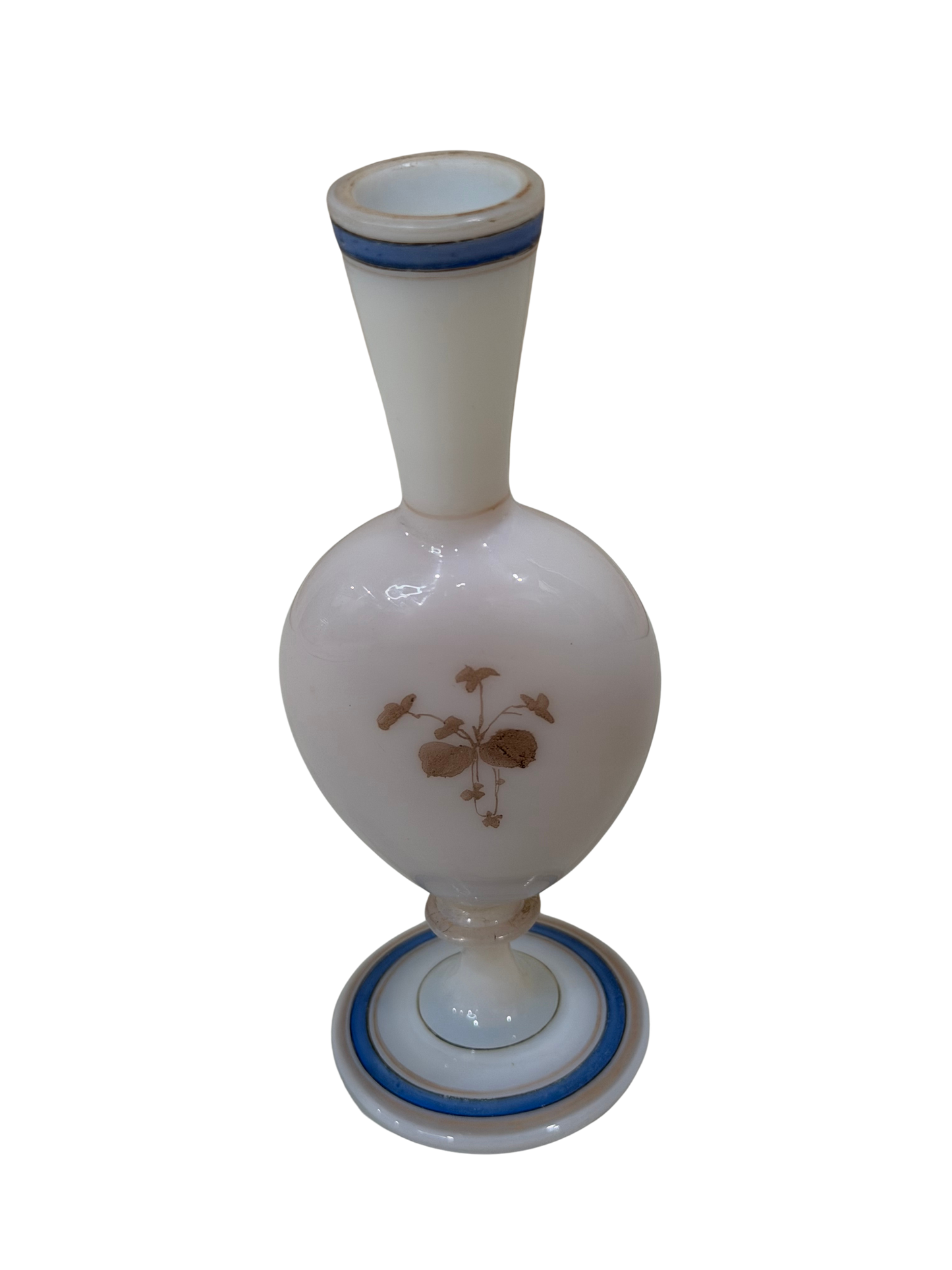
A charming antique opaque white glass bud vase of slender bottle form, raised on a circular pedestal foot and decorated with delicate hand-painted floral motifs.
The rounded body features a colorful botanical composition centered by a large pink blossom surrounded by orange bell-shaped flowers, green foliage, and finely painted grasses. The reverse is accented with a small gilt botanical sprig. Rich cobalt-blue bands encircle both the mouth and foot, further detailed with fine gilt lines.
The softly translucent, milky-white glass and hand-painted decoration are characteristic of decorative glass produced throughout Europe during the Victorian period. Its petite scale and graceful proportions make it especially appealing displayed among antique perfume bottles, vanity pieces, or a collection of 19th-century art glass.
A charming antique opaque white glass bud vase of slender bottle form, raised on a circular pedestal foot and decorated with delicate hand-painted floral motifs.
The rounded body features a colorful botanical composition centered by a large pink blossom surrounded by orange bell-shaped flowers, green foliage, and finely painted grasses. The reverse is accented with a small gilt botanical sprig. Rich cobalt-blue bands encircle both the mouth and foot, further detailed with fine gilt lines.
The softly translucent, milky-white glass and hand-painted decoration are characteristic of decorative glass produced throughout Europe during the Victorian period. Its petite scale and graceful proportions make it especially appealing displayed among antique perfume bottles, vanity pieces, or a collection of 19th-century art glass.
5.5"h x 2.25"w x 2"d
5.5"h x 2.25"w x 2"d
Opaque and opaline-style glass became particularly fashionable during the 19th century, with decorative glasshouses in England, France, and Bohemia producing vessels embellished with enamel-painted flowers, gilding, and colored borders.
This example shares characteristics with Victorian Bristol-type and Continental European opaque glass, including its white glass body, hand-painted naturalistic flowers, cobalt-blue banding, and gilt accents. In the absence of a visible maker's mark, a more specific factory attribution cannot be confirmed.
The bottle-like form may have been produced as a small decorative vase or vanity vessel. No stopper is present, and it is therefore best described conservatively as a bud vase or bottle-form decorative vessel rather than definitively as a perfume bottle.
Opaque and opaline-style glass became particularly fashionable during the 19th century, with decorative glasshouses in England, France, and Bohemia producing vessels embellished with enamel-painted flowers, gilding, and colored borders.
This example shares characteristics with Victorian Bristol-type and Continental European opaque glass, including its white glass body, hand-painted naturalistic flowers, cobalt-blue banding, and gilt accents. In the absence of a visible maker's mark, a more specific factory attribution cannot be confirmed.
The bottle-like form may have been produced as a small decorative vase or vanity vessel. No stopper is present, and it is therefore best described conservatively as a bud vase or bottle-form decorative vessel rather than definitively as a perfume bottle.
Victorian, circa 1870–1900
Victorian, circa 1870–1900
Opaque / opaline glass
Hand-painted enamel decoration
Cobalt-blue enamel
Gilt detailing
Opaque / opaline glass
Hand-painted enamel decoration
Cobalt-blue enamel
Gilt detailing
France
France
Antique condition with age-appropriate wear. Visible rubbing and loss to portions of the gilt decoration and rim detailing, along with minor surface wear consistent with age and handling. Please review all photographs carefully as they form an important part of the condition description.
Dating and origin are based on construction, materials, decorative technique, and stylistic comparison. No maker's mark is visible in the supplied photographs, and the precise glasshouse or country of manufacture cannot be definitively attributed.
Due to the handmade nature of antique glass, minor irregularities, bubbles, variations in coloration, and imperfections may be present and are considered characteristic rather than manufacturing defects.
Antique condition with age-appropriate wear. Visible rubbing and loss to portions of the gilt decoration and rim detailing, along with minor surface wear consistent with age and handling. Please review all photographs carefully as they form an important part of the condition description.
Dating and origin are based on construction, materials, decorative technique, and stylistic comparison. No maker's mark is visible in the supplied photographs, and the precise glasshouse or country of manufacture cannot be definitively attributed.
Due to the handmade nature of antique glass, minor irregularities, bubbles, variations in coloration, and imperfections may be present and are considered characteristic rather than manufacturing defects.