


Vintage Chinese Cloisonné Enamel Floral Lidded Box with Gilt Ground, Mid-20th Century
Vintage Chinese Cloisonné Enamel Floral Lidded Box with Gilt Ground, Mid-20th Century
Impossible de charger la disponibilité du service de retrait
Partager


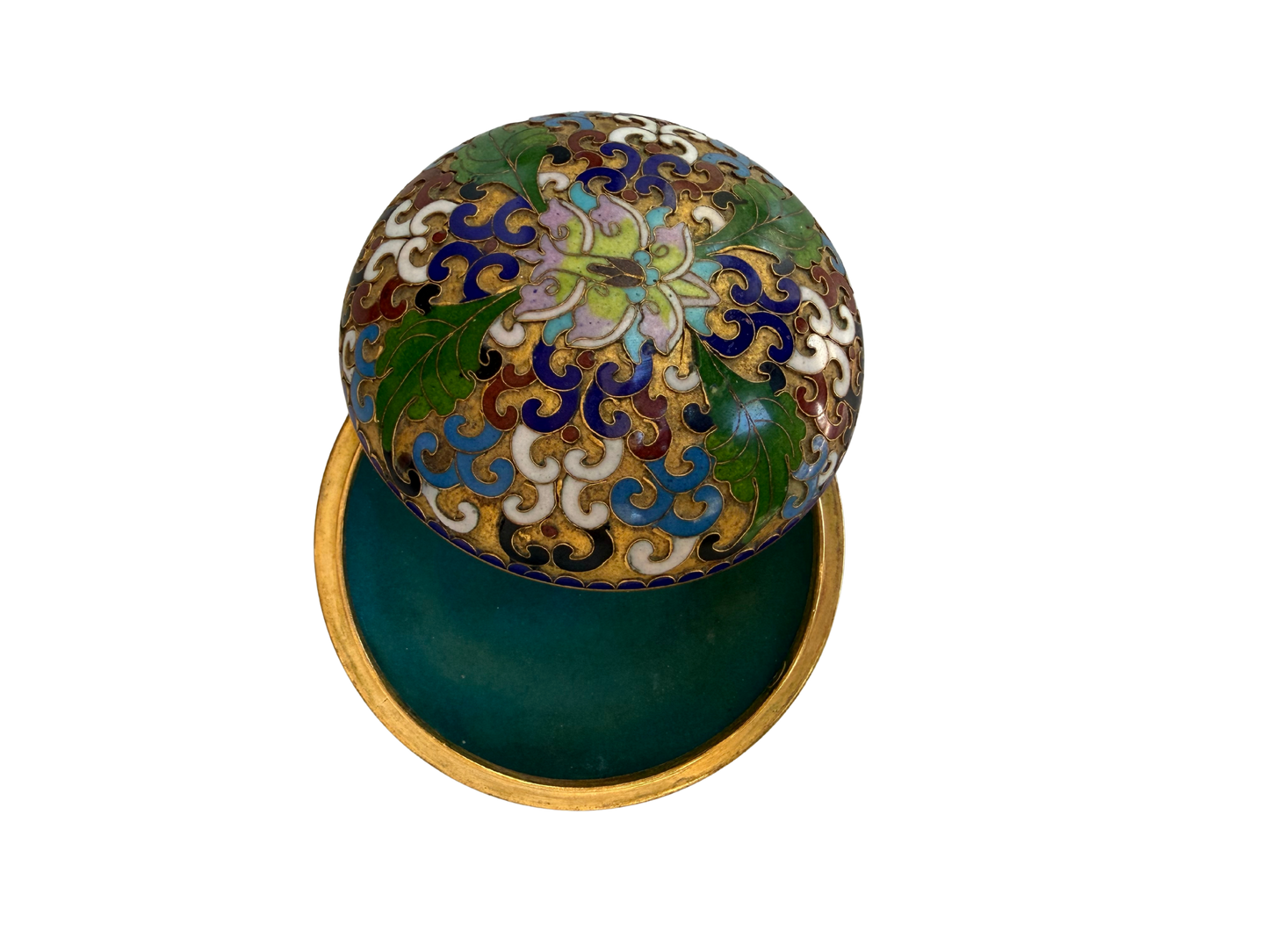
A richly decorated vintage Chinese cloisonné enamel lidded box of compressed circular form, worked in a vibrant palette of cobalt blue, turquoise, emerald green, white, burgundy, lavender, and pale pink against a lustrous gilt ground.
The domed lid is centered by a large stylized lotus-like blossom surrounded by broad green leaves and an intricate field of scrolling cloud and foliate motifs. Fine gilt-metal wires, or cloisons, separate the individual areas of colored enamel and create the elaborate linear pattern characteristic of traditional Chinese cloisonné.
The decoration continues around the sides of both the lid and base, with repeating scrolling motifs and a narrow cobalt-blue border accentuating the seam between the two halves.
Opening the box reveals a smooth turquoise-blue enamel interior bordered by gilt metal. The low, rounded silhouette and exceptionally dense surface decoration give the piece the appearance of a small jewel box.
A wonderfully colorful decorative object, ideal for jewelry, small keepsakes, or display among a collection of Asian decorative arts.
A richly decorated vintage Chinese cloisonné enamel lidded box of compressed circular form, worked in a vibrant palette of cobalt blue, turquoise, emerald green, white, burgundy, lavender, and pale pink against a lustrous gilt ground.
The domed lid is centered by a large stylized lotus-like blossom surrounded by broad green leaves and an intricate field of scrolling cloud and foliate motifs. Fine gilt-metal wires, or cloisons, separate the individual areas of colored enamel and create the elaborate linear pattern characteristic of traditional Chinese cloisonné.
The decoration continues around the sides of both the lid and base, with repeating scrolling motifs and a narrow cobalt-blue border accentuating the seam between the two halves.
Opening the box reveals a smooth turquoise-blue enamel interior bordered by gilt metal. The low, rounded silhouette and exceptionally dense surface decoration give the piece the appearance of a small jewel box.
A wonderfully colorful decorative object, ideal for jewelry, small keepsakes, or display among a collection of Asian decorative arts.
1.75"h x 3.75"diam
1.75"h x 3.75"diam
Cloisonné is an ancient enameling technique in which fine metal wires are attached to a metal body to create individual compartments, or cloisons. These compartments are filled with colored enamel, fired, polished smooth, and traditionally finished with gilded exposed metalwork.
Chinese artisans developed cloisonné into one of the country's most recognizable decorative arts, particularly during the Ming and Qing dynasties. The technique became so closely associated with blue enamel during the reign of the Jingtai Emperor that Chinese cloisonné is traditionally known as jingtailan, or “Jingtai blue.”
Floral scrolls and lotus blossoms became enduring motifs in Chinese cloisonné. Qing dynasty circular boxes survive with closely related scrolling-lotus decoration, demonstrating how deeply established this ornamental vocabulary became.
During the late 19th and especially the 20th century, Chinese workshops continued producing cloisonné for both domestic and export markets, frequently adapting historic Ming and Qing decorative patterns into brightly colored boxes, bowls, vases, and other ornamental objects.
The present piece appears consistent with this later revival tradition rather than an early Imperial-period object and is therefore conservatively dated to the mid-20th century.
Cloisonné is an ancient enameling technique in which fine metal wires are attached to a metal body to create individual compartments, or cloisons. These compartments are filled with colored enamel, fired, polished smooth, and traditionally finished with gilded exposed metalwork.
Chinese artisans developed cloisonné into one of the country's most recognizable decorative arts, particularly during the Ming and Qing dynasties. The technique became so closely associated with blue enamel during the reign of the Jingtai Emperor that Chinese cloisonné is traditionally known as jingtailan, or “Jingtai blue.”
Floral scrolls and lotus blossoms became enduring motifs in Chinese cloisonné. Qing dynasty circular boxes survive with closely related scrolling-lotus decoration, demonstrating how deeply established this ornamental vocabulary became.
During the late 19th and especially the 20th century, Chinese workshops continued producing cloisonné for both domestic and export markets, frequently adapting historic Ming and Qing decorative patterns into brightly colored boxes, bowls, vases, and other ornamental objects.
The present piece appears consistent with this later revival tradition rather than an early Imperial-period object and is therefore conservatively dated to the mid-20th century.
Chinese, likely mid-20th century, circa 1930–1970
Chinese, likely mid-20th century, circa 1930–1970
Cloisonné enamel over copper or copper-alloy body; gilt metal.
Cloisonné enamel over copper or copper-alloy body; gilt metal.
Private collection. No maker's mark or reign mark observed in the photographs provided.
Private collection. No maker's mark or reign mark observed in the photographs provided.
Vintage condition consistent with age and display. The enamels exhibit minor surface wear, scattered scratches, small irregularities, and localized discoloration.
The gilt-metal surfaces show expected rubbing, patination, and finish variation. Small pits, firing irregularities, and slight variations in enamel height are characteristic of cloisonné manufacture and should not necessarily be considered later damage.
The turquoise enamel interior exhibits light surface wear consistent with use.
No significant losses or major structural damage are visible from the photographs provided; however, minor enamel flakes, hairlines, flea bites, or edge wear may be present.
Please review all photographs carefully, as they form an important part of the condition description.
Vintage condition consistent with age and display. The enamels exhibit minor surface wear, scattered scratches, small irregularities, and localized discoloration.
The gilt-metal surfaces show expected rubbing, patination, and finish variation. Small pits, firing irregularities, and slight variations in enamel height are characteristic of cloisonné manufacture and should not necessarily be considered later damage.
The turquoise enamel interior exhibits light surface wear consistent with use.
No significant losses or major structural damage are visible from the photographs provided; however, minor enamel flakes, hairlines, flea bites, or edge wear may be present.
Please review all photographs carefully, as they form an important part of the condition description.