



Vintage Italian Oak Spiral Staircase-Form Display Stand / Whatnot, Circa 1920–1950
Vintage Italian Oak Spiral Staircase-Form Display Stand / Whatnot, Circa 1920–1950
Impossible de charger la disponibilité du service de retrait
Partager


A wonderfully unusual Italian decorative display stand crafted in oak and designed in the whimsical form of a miniature spiral staircase.
Four graduated wedge-shaped shelves ascend around a tall turned central newel post, creating the appearance of a winding staircase in miniature. Turned supports connect the individual tiers, while curved outer rails follow the sweep of the staircase and reinforce its architectural silhouette. The principal post rises dramatically above the uppermost tier and terminates in a rounded finial.
The warm-toned oak displays attractive visible grain throughout, complemented by understated turned details that allow the sculptural construction itself to remain the principal decorative feature.
Likely intended as a novelty display stand for small plants, ceramics, photographs, or objets d'art, the piece is both functional and highly decorative. Its compact footprint also allows it to fit naturally into a corner while maintaining the visual effect of a freestanding spiral staircase.
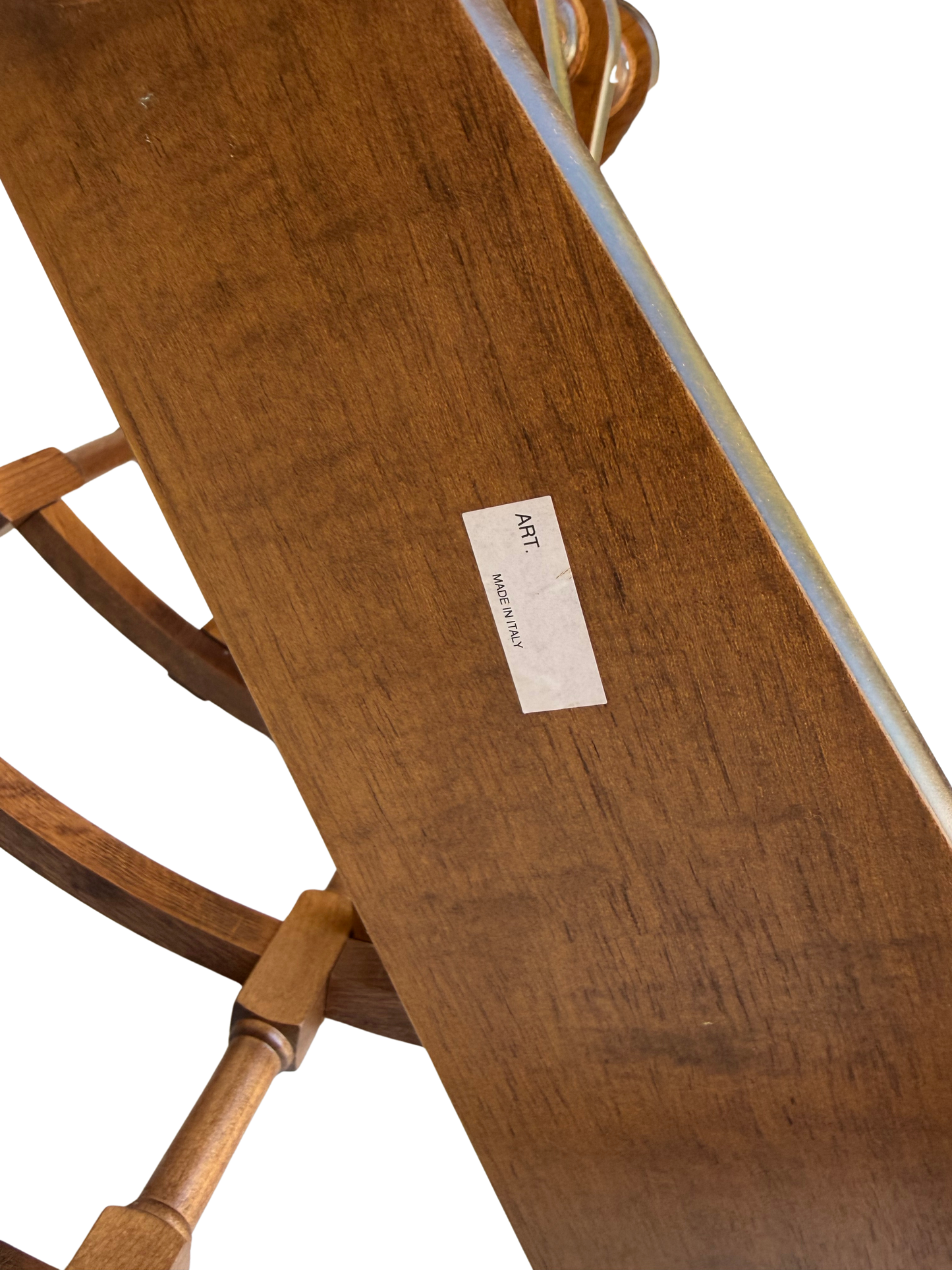
The underside retains a period paper label marked “ART.” and “MADE IN ITALY,” confirming Italian manufacture.
A wonderfully unusual Italian decorative display stand crafted in oak and designed in the whimsical form of a miniature spiral staircase.
Four graduated wedge-shaped shelves ascend around a tall turned central newel post, creating the appearance of a winding staircase in miniature. Turned supports connect the individual tiers, while curved outer rails follow the sweep of the staircase and reinforce its architectural silhouette. The principal post rises dramatically above the uppermost tier and terminates in a rounded finial.
The warm-toned oak displays attractive visible grain throughout, complemented by understated turned details that allow the sculptural construction itself to remain the principal decorative feature.
Likely intended as a novelty display stand for small plants, ceramics, photographs, or objets d'art, the piece is both functional and highly decorative. Its compact footprint also allows it to fit naturally into a corner while maintaining the visual effect of a freestanding spiral staircase.
The underside retains a period paper label marked “ART.” and “MADE IN ITALY,” confirming Italian manufacture.
47.75"h x 18"w x 25"d
47.75"h x 18"w x 25"d
Italian decorative furniture of the late 19th and early 20th centuries frequently drew upon historic architectural forms while also embracing whimsical and highly sculptural designs intended for increasingly eclectic domestic interiors.
Small display stands, plant stands, and étagères were particularly well suited to this tradition, allowing cabinetmakers to experiment with turned woodwork and architectural motifs on a more intimate scale.
This example takes its inspiration directly from the spiral or winding staircase, with the individual display tiers functioning visually as steps revolving around a tall central newel post. The design transforms a utilitarian shelving form into a miniature architectural object.
Although related in function to a traditional corner whatnot or étagère, its staircase construction is sufficiently distinctive that “spiral staircase-form display stand” more accurately describes the piece.
The surviving “MADE IN ITALY” label establishes Italian manufacture and suggests that the piece may have been produced for the decorative export market during the first half of the 20th century.
Italian decorative furniture of the late 19th and early 20th centuries frequently drew upon historic architectural forms while also embracing whimsical and highly sculptural designs intended for increasingly eclectic domestic interiors.
Small display stands, plant stands, and étagères were particularly well suited to this tradition, allowing cabinetmakers to experiment with turned woodwork and architectural motifs on a more intimate scale.
This example takes its inspiration directly from the spiral or winding staircase, with the individual display tiers functioning visually as steps revolving around a tall central newel post. The design transforms a utilitarian shelving form into a miniature architectural object.
Although related in function to a traditional corner whatnot or étagère, its staircase construction is sufficiently distinctive that “spiral staircase-form display stand” more accurately describes the piece.
The surviving “MADE IN ITALY” label establishes Italian manufacture and suggests that the piece may have been produced for the decorative export market during the first half of the 20th century.
Italian, mid-20th century
Italian, mid-20th century
Oak and secondary woods
Oak and secondary woods
Private collection. Retains an underside paper label reading “ART.” and “MADE IN ITALY.” Acquired in an Austin, TX estate
Private collection. Retains an underside paper label reading “ART.” and “MADE IN ITALY.” Acquired in an Austin, TX estate
Vintage condition consistent with age and use. The wood exhibits scattered scratches, abrasions, finish variation, small marks, edge wear, and areas of natural darkening throughout.
Open furniture of this construction may exhibit minor age-related movement at joints and supports. Small separations, old repairs, or later tightening may be present.
The original or period paper manufacturer's/export label remains affixed beneath one tier and displays expected age-related wear.
This piece is being represented as a decorative display stand and not as a functional staircase or stepladder. It should not be climbed upon or used to support a person's weight.
Please review all photographs carefully, as they form an important part of the condition description.
Vintage condition consistent with age and use. The wood exhibits scattered scratches, abrasions, finish variation, small marks, edge wear, and areas of natural darkening throughout.
Open furniture of this construction may exhibit minor age-related movement at joints and supports. Small separations, old repairs, or later tightening may be present.
The original or period paper manufacturer's/export label remains affixed beneath one tier and displays expected age-related wear.
This piece is being represented as a decorative display stand and not as a functional staircase or stepladder. It should not be climbed upon or used to support a person's weight.
Please review all photographs carefully, as they form an important part of the condition description.